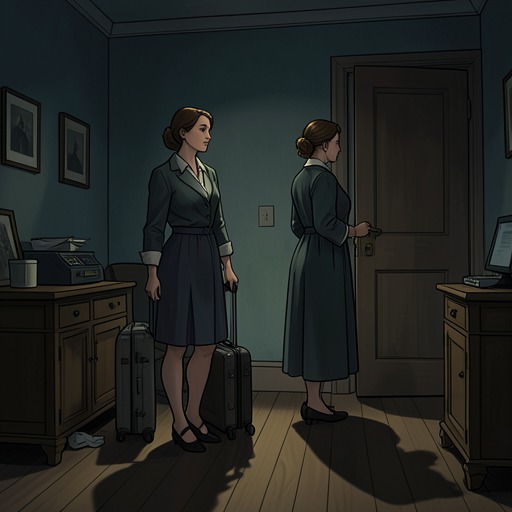
Jana
You Should Have LeftJana is introduced as a lively, physically expressive figure whose friendship with Ella initially carries the bright, comic energy of a film opening. On a tandem bicycle traveling along a country road, Ella steers while Jana spreads her arms and blinks happily into the sun. The ride ends abruptly when the bicycle strikes a rock, leaves the road, and overturns amid cries of pain. The accident establishes Jana and Ella’s relationship through shared movement and shared vulnerability, while also placing Jana inside a story whose cheerful surface can break without warning.
Identity and Introduction
Jana is associated with spontaneity, theatricality, and a notorious lack of self-control. The sequel’s problem is not how to introduce her, since the first film has already established the principal characters, but how to supply convincing backstory for them. The narrator openly admits that nothing is known about Jana’s childhood and that her early life does not interest him, refusing the conventional flashback as a ready-made explanation. Jana therefore enters the new story not through a formative childhood scene but through a present-tense crisis involving friendship, housing, and an old romance.
Her impulsiveness is treated as a recognized feature of her character. The narrator recalls an earlier outburst in which she abruptly told a gym teacher that people like him lent the word stupidity new majesty. That memory creates an expectation that being expelled from Ella’s apartment will provoke another spectacular verbal explosion. Jana’s importance lies partly in the pressure generated by that expectation: the story has taught its audience to anticipate her anger, then makes her behavior contradict the anticipated version of herself.
Life and Plot Trajectory
The immediate crisis begins when Ella asks Jana to leave the apartment where Jana had been living. Ella’s new boyfriend, Martin, is to move in. Jana and Martin had previously been together, but she ended the relationship because he was a senior tax official. The narrator presents Martin as handsome, sensitive, well-read, and multilingual, qualities that make Jana’s rejection of him less a matter of personal inadequacy than of her comic resistance to what his profession represents. Her former relationship with Martin gives Ella’s request an additional charge: Jana is not merely losing a home to a friend’s new partner but is being displaced by her own ex-boyfriend.
The expected confrontation does not occur. Jana remains calm when Ella tells her to move out, and this composure is so surprising that Ella experiences it as provocation. Ella insists that Jana had not wanted to live there anymore, attempting to turn the eviction into the confirmation of Jana’s own prior wish. Jana answers without the rage everyone is waiting for. When Martin enters in a suit with a briefcase under his arm, Ella redirects her anger toward him, while Jana stands nearby, not smiling but sadly. Her restraint changes the emotional geometry of the scene: instead of giving Ella a familiar target, Jana leaves the others to expose their own agitation.
Jana later appears in a new apartment, seated on a couch with a laptop, when Ella storms in. The contrast between the two women is reversed: Jana is now stationary and weary, while Ella arrives carrying the force of an unresolved crisis. Jana’s response is to let Ella speak rather than to seize control of the exchange. The new apartment marks the practical consequence of her removal from Ella’s home, but it also makes her a witness to the continuing disorder that the move was supposed to settle.
Jana’s story is intercut with the narrator’s attempts to write the sequel. He explains to producer Schmidt that Jana has to move out because Ella throws her out and Martin wants to move in. The plot is thus presented as both an event in the fictional film and a problem in the outer narrative: the narrator must invent complications for Jana and Ella while his own life is becoming increasingly difficult to separate from the material he is writing. Jana’s displacement becomes one of the first visible points at which the film project’s fictional crises mirror the surrounding household’s instability.
Relationships and Conflict
Jana’s bond with Ella is defined as a close friendship but is not protected from rivalry, resentment, or asymmetrical power. Ella has the authority to tell Jana to leave, and Jana’s former residence in the apartment makes the request a direct alteration of their shared history. The scene’s tension comes from the mismatch between Ella’s expectation of Jana’s anger and Jana’s refusal to provide it. Her calm does not repair the relationship; instead, it makes Ella feel challenged. The friendship therefore turns on a paradox: Jana’s self-control, apparently the quality Ella should welcome, becomes intolerable because it deprives Ella of the emotional response she expects to govern.
Martin complicates the friendship further. He is both Ella’s new boyfriend and Jana’s ex-boyfriend, and his arrival converts a private housing dispute into a triangular conflict. Jana had rejected him for being a tax official, a judgment that the narrator treats with comic exaggeration, but Martin’s profession becomes an emblem of the orderly adult identity against which Jana defines herself. The irony is sharpened when Martin later looks at his colleagues and suddenly sees them as others see him: tax officials. He examines photographs from school and university, loosens his tie, tightens it again, and then orders a tax audit of a casually dressed pop singer before deliberately loosening the tie once more. Jana’s earlier objection to Martin’s profession consequently reverberates through his own uneasy recognition of what he has become.
Jana’s conflict is not restricted to the film’s interpersonal plot. The narrator’s domestic writing scene places her alongside the pressures of work and family. He keeps scribbling so that Susanna will think he is working while the children play loudly on the carpet, because the production is waiting for him. Jana and Ella’s invented conflict is therefore produced within a household already organized by divided attention, resentment, and performance. The narrator writes their scenes as if busyness could hold reality together, just as Jana’s controlled manner temporarily holds her own humiliation in check.
Change and Narrative Role
Jana’s decisive change is behavioral rather than explanatory. The text refuses to account for her through childhood history and instead tests the character against a situation designed to trigger her established weakness. The woman known for impulsive verbal attack does not explode when Ella removes her from the apartment. She remains composed, then stands sadly as Ella screams at Martin. This is a genuine reversal of the character’s expected pattern, but the narrative does not present it as uncomplicated maturity. Her calm can be read as dignity, exhaustion, strategic silence, or a refusal to participate in Ella’s script; the evidence leaves the motive open while making the change unmistakable.
Jana also functions as a structural hinge between comedy and darker forms of narrative. The bicycle sequence promises cheerful physical comedy before ending in injury. Her eviction is framed as a setup for an expected comic outburst, yet the outburst fails to arrive. Later, the narrator’s film plot is increasingly surrounded by ominous drives, empty reflections, warnings to get away, and spatial disturbances. The Jana-and-Ella material belongs to the recognizable social world of apartments, former lovers, and arguments, but its instability helps prepare the larger movement from comic sequel-making toward a story of entrapment.
The character’s name repeatedly returns as a problem the narrator must solve. He asks who David is and circles around possibilities without reaching an answer, while the pages of his notebook hold descriptions of driving to the village and buying groceries as well as the unfinished Jana-and-Ella scenes. Jana is therefore not only a participant in the internal screenplay but also evidence of the narrator’s failing control over his own narrative. Her plot can be summarized in practical terms—she is expelled, moves into a new apartment, and confronts Ella again—but its consequences spread beyond that plot, exposing how little authority the narrator retains over the people he claims to create.
Narrative Significance
Jana’s significance lies in the gap between the character everyone remembers and the person the new crisis produces. The expected Jana is explosive; the observed Jana is quiet and sad. That gap makes her one of the clearest examples of the book’s concern with unreliable construction: a character can be described, predicted, and placed into a familiar dramatic function, yet still refuse to behave according to the blueprint. Her lack of supplied childhood history is not simply an omission; it foregrounds the artificiality of character-making and makes the present scene carry the burden of revelation.
She also embodies the book’s recurring tension between ordinary movement and forces that redirect it. On the tandem bicycle, Jana’s open-armed pleasure ends when a rock sends the vehicle off the road. In the apartment plot, her established place beside Ella ends when Martin’s arrival displaces her. In the larger narrative, everyday routes—driving down hairpin bends to the village, shopping at Gruntner’s General Store, and returning to the house—become charged with danger and disorientation. Jana’s own trajectory begins in motion and comic openness, then narrows into eviction, sadness, and an unresolved position within a story whose spaces and identities no longer remain stable.